How To Write Your Script With 120min Runtime
Plan a two-hour screenplay by mapping the protagonist’s journey across setup, confrontation, and resolution, then turning major beats into scenes.
By My Logline Editorial
Plan a two-hour screenplay by mapping the protagonist’s journey across setup, confrontation, and resolution, then turning major beats into scenes. A 120-page outline can be a useful starting model, but page count does not measure runtime exactly. Adjust the plan for performance, action, genre, and the story’s emotional rhythm.
How to write your script with 120min runtime, a structured planning for any genre
Writing a 120-minute (120-page) script requires a clear structural blueprint.
The industry standard is 1 page = 1 minute of screen time. Here's a structured planning guide that works for any genre:
Core Framework: Three-Act Structure (120 pages)
If the page ranges feel abstract, first build your turning points with How To Convert A Story Idea Into A Full Movie Structure. Then place those events on the runtime plan so the outline grows from your character’s journey.
| Act | Pages | Runtime | % of Script | Purpose |
|---|---|---|---|---|
| Act 1: Setup | 1–30 | 0–30 min | 25% | Establish protagonist, world, inciting incident, act break |
| Act 2: Confrontation | 31–90 | 30–90 min | 50% | Rising action, midpoint, betrayal, lowest point |
| Act 3: Resolution | 91–120 | 90–120 min | 25% | Climax, fallout, coda |

\\
15-Beat "Save the Cat" Breakdown (Perfect for 120 Pages)
| Beat | Page | What Happens |
|---|---|---|
| 1. Opening Image | 1 | Visual snapshot of protagonist's ordinary world |
| 2. Theme Stated | 5 | Someone hints at the story's lesson |
| 3. Set-Up | 1–10 | Introduce characters, flaws, wants, world |
| 4. Catalyst (Inciting Incident) | 12–15 | Life-changing event disrupts ordinary world . |
| 5. Debate | 15–25 | Protagonist hesitates before committing |
| 6. Break into Act 2 | 25–30 | Protagonist chooses the journey; no turning back . |
| 7. B Story | ~30 | Supporting relationship/subplot begins |
| 8. Fun & Games | 30–55 | Genre promise—comedy gags, thriller chases, romance tension . |
| 9. Midpoint | ~60 | False victory/defeat; stakes rise dramatically . |
| 10. Bad Guys Close In | 60–75 | Antagonist gains ground; internal/external pressure |
| 11. All Is Lost | ~75–90 | Lowest point; "whiff of death"Hope seems gone . |
| 12. Dark Night of the Soul | 90–95 | Protagonist hits rock bottom, reflects |
| 13. Break into Act 3 | 95–100 | Protagonist discovers solution/lesson |
| 14. Climax | 100–115 | Final showdown; protagonist applies lesson |
| 15. Final Image | 120 | Contrast with Opening Image—shows transformation |
Tip: Analyse this for any favourite film of yours to get a better idea.
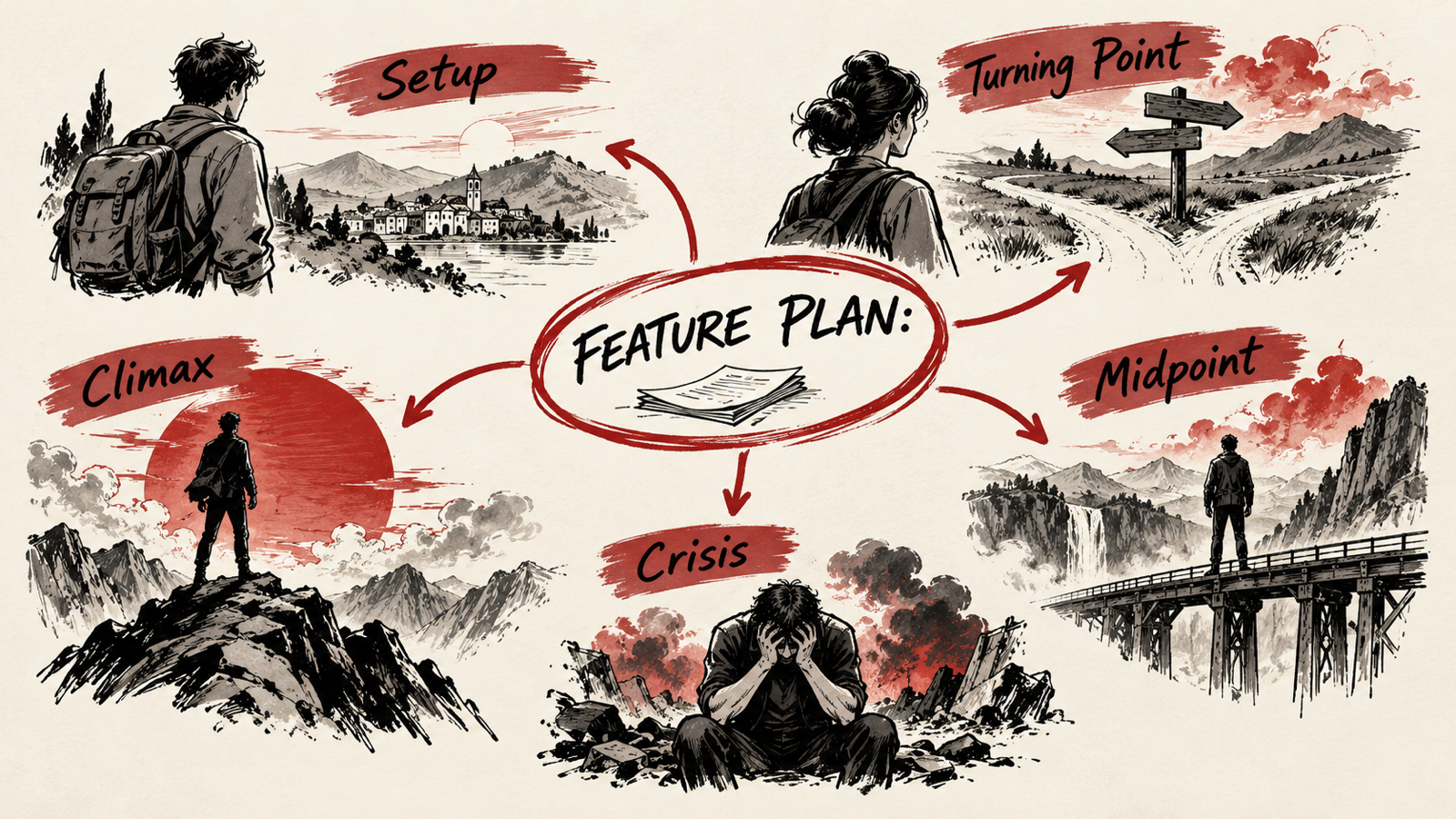
Genre-Specific Adjustments
| Genre | Structural Focus | Key Timing |
|---|---|---|
| Comedy | Premise-driven gags; character learns lesson | Fun & Games (30–55) packed with jokes; climax resolves relationship . |
| Thriller/Mystery | Escalating tension; clue placement | Inciting incident by p.15; ticking clock from midpoint; revelation at climax . |
| Horror | Dread-building; scare pacing | Threat introduced by p.20; escalating encounters; horror confrontation at climax |
| Romance | Attraction→Conflict→Reunion | Meet-cute by p.10; forced separation at midpoint; reunion at climax |
| Drama | Character arc-driven; high stakes | Every scene must advance plot/character; no formulaic beats . |
| Action | Set pieces; clear hero's journey | Hero's Journey beats; more action description; climax = big battle . |
| Fantasy/Sci-Fi | World-building integration | Gradual world reveal; hero's journey; climax convergence |
Step-by-Step Planning Process
Turn this planning process into daily work with How To Finish Your Script In 14 Days. Use its outline and scene-list stages to decide what you will complete before beginning the draft.
1. Pre-Writing (Concept → Outline)
-
Create your story concept (one-sentence logline)
-
Develop characters (protagonist's want, flaw, need).
-
Write a 1-page synopsis (beginning, middle, end)
-
Create a beat sheet (15 beats above)
-
Break into scene list (40 strong beats/scenes)
2. Writing the Draft
-
Use 12pt Courier font, standard margins
-
Scene heading format: EXT. LOCATION – DAY
-
Write in present tense.
-
Don't edit while writing—let ideas flow
3. Pacing Checklist
-
First 5 pages: Hook the reader immediately.
-
Page 15: Inciting incident (not past page 20).
-
Page 30: Act 1 break (protagonist chooses journey).
-
Page 60: Midpoint (stakes escalate).
-
Page 90: All is lost (lowest point).
-
Pages 100–115: Climax sequence
-
Page 120: Final image (show transformation)
4. Revision
As you review the pages, apply 15 Storytelling Tricks Every Director Must Learn to the scenes themselves. Check whether each scene contains a clear want, an obstacle, and a change that earns its place in the runtime.
-
Take a break before editing.
-
Check each scene advances plot OR character.
-
Ensure genre expectations are met (genre = why audience shows up; structure = why they stay)
-
Keep script under 120 pages—longer scripts are often rejected.
Quick Template for Your Script
ACT 1 (pp. 1–30)

\- Opening Image (p.1)

\- Set-up: Protagonist's world + flaw (pp. 1–10)

\- Catalyst (p. 12–15)

\- Debate (pp. 15–25)

\- Break into Act 2 (p. 25–30)


ACT 2 (pp. 31–90)

\- B Story begins (p. 30)

\- Fun & Games / Genre promise (pp. 30–55)

\- Midpoint (p. 60)

\- Bad Guys Close In (pp. 60–75)

\- All Is Lost (p. 75–90)

\- Dark Night of the Soul (pp. 90–95)


ACT 3 (pp. 91–120)

\- Break into Act 3 (pp. 95–100)

\- Climax (pp. 100–115)

\- Final Image (p. 120)

* * *
Key principle: Structure reveals character and plot; genre sets audience expectations. Study your genre's conventions but don't let gags/events replace story. The 3-act structure works because it creates a compelling trajectory with highs, lows, complications, and transformation
Frequently asked questions
Does one screenplay page always equal one minute?
No. It is a rough planning convention. Dialogue, action, performance, pauses, formatting, and editing can make a page play faster or slower.
Must every feature script have exactly 120 pages?
No. Appropriate length depends on the story, format, recipient’s requirements, and practical production considerations. Use a page plan to evaluate scope rather than treating it as a universal limit.
Plan and format your feature screenplay in My Logline.