Explaining Screenwriting Concepts In Simple Terms - Part 2
Deeper screenwriting depends on controlling meaning, expectation, and consequence.
By My Logline Editorial
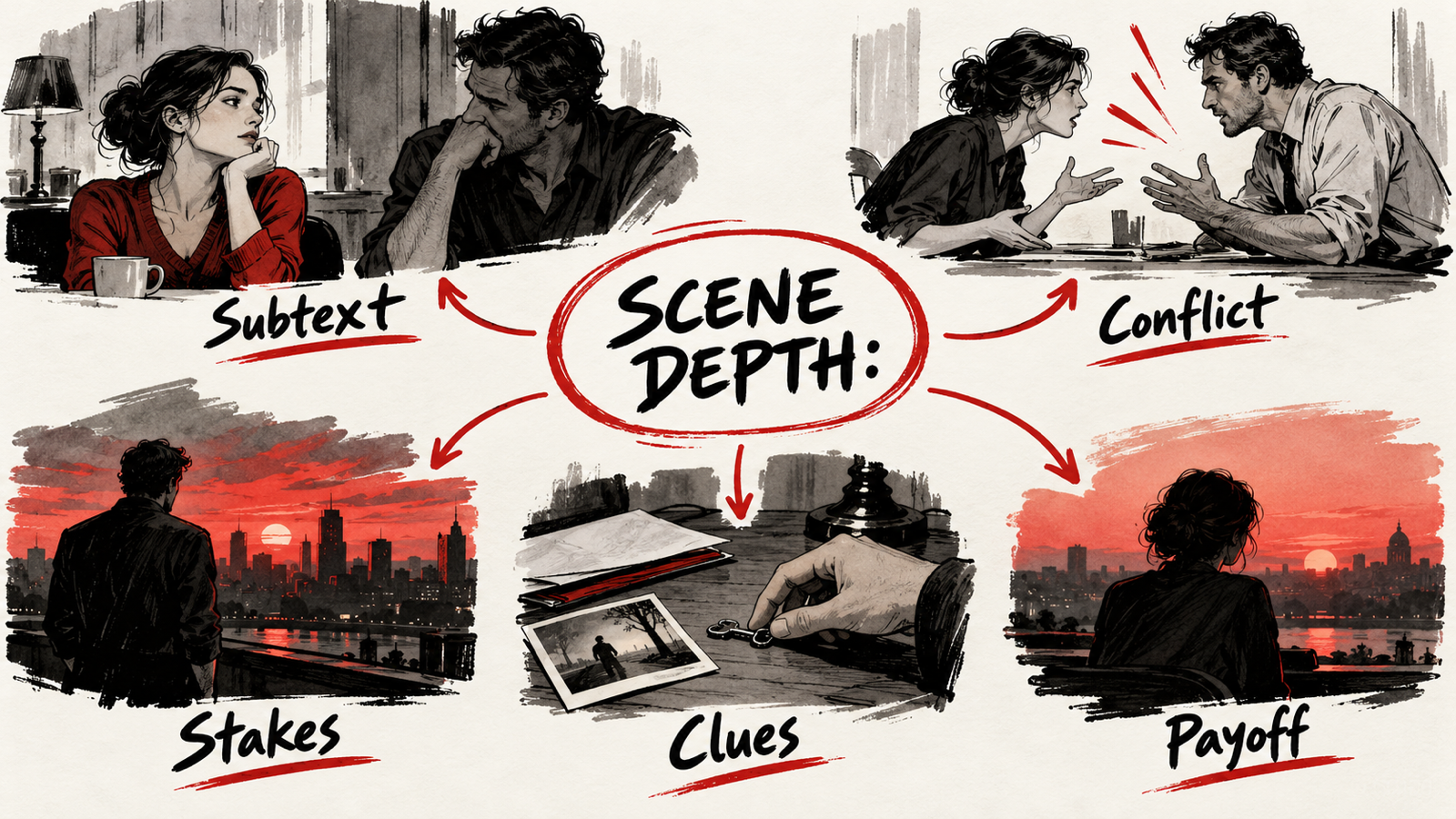
Deeper screenwriting depends on controlling meaning, expectation, and consequence. Subtext creates a gap between words and intention; conflict drives choices; stakes make outcomes matter. Foreshadowing, fair twists, and purposeful cliffhangers connect those choices across scenes, while consistent worldbuilding makes the pressures around the characters believable.
Once you understand basic structure, the next challenge is controlling what a scene means and what the audience expects. Subtext, twists, cliffhangers, stakes, conflict, foreshadowing, and worldbuilding help make the story feel connected from moment to moment.

Write subtext beneath the dialogue
Know what a character consciously wants, what they fear, and what they cannot admit. Create a gap between their words and their intention. A pause, an action, or a familiar object can reveal that gap. Use natural speech, interruptions, humour, and deflection. Read the exchange aloud and remove explanations that flatten it. The dialogue guidance in How To Write A Family Drama - Writing Framework is useful when love, ego, and resentment occupy the same conversation.
Make a plot twist change the meaning
Begin with a stable situation the audience understands. Plant clues early, then guide attention toward a believable alternative explanation. The reveal should alter our understanding of a character, event, or choice. Give it an emotional consequence and check that it fits the earlier scenes. Revisit the story after revealing the truth: the clues should still make sense.
Build cliffhangers around consequences
End on a discovery, decision, danger, or unanswered question that matters. You can interrupt an action, withhold part of a revelation, or show a change whose consequences remain uncertain. Make the uncertainty specific and plan its payoff. How To Write 2-Minute Reel Series applies that curiosity to short episodes, where a hook must be supported by an emotional reason to return.
Make the stakes personal
Ask what the character loses if they fail. The answer might involve life, freedom, love, reputation, identity, or belonging. Show the cost through consequences rather than announcements. As the story develops, close off easy options and increase the difficulty of the choice. Recheck the final act: the audience should understand why this particular outcome matters.
Create conflict that drives action
Put the protagonist against a person, an institution, nature, technology, the unknown, or their own competing desires. Two people can both have understandable goals and still obstruct one another. Keep the conflict active through attempts, resistance, setbacks, and decisions. 15 Storytelling Tricks Every Director Must Learn helps connect those scene-level struggles to the character’s larger transformation.

Foreshadow with a promise you can fulfil
Introduce a meaningful detail before its payoff: an object, line, habit, warning, image, or absence. Give it an ordinary role when it first appears so it belongs in the scene. Repetition, contrast, and motifs can build recognition. When it returns, let it change our understanding or affect the action. A payoff earns its power from what the audience has already experienced.
Make the world feel lived in
Start with the world’s core idea, then consider geography, history, culture, social systems, rules, and limits. Show how those things affect everyday choices. Give the place contradictions, competing beliefs, and details beyond the protagonist’s immediate needs. Reveal the world through action and relationships, and keep its rules consistent when conflict puts them under pressure. How To Write A Thriller - Writing Framework offers a focused example of managing information, threat, and audience expectation.
Frequently asked questions
How can I write subtext without confusing the audience?
Make the situation and the character’s desire understandable, then let words, pauses, and behaviour reveal a different intention. The audience needs enough context to infer what remains unsaid.
What makes a plot twist feel earned?
A twist feels earned when earlier details support the new interpretation and the reveal changes something emotionally or dramatically. Surprise alone cannot replace coherent cause and effect.
Use My Logline to write your film.